
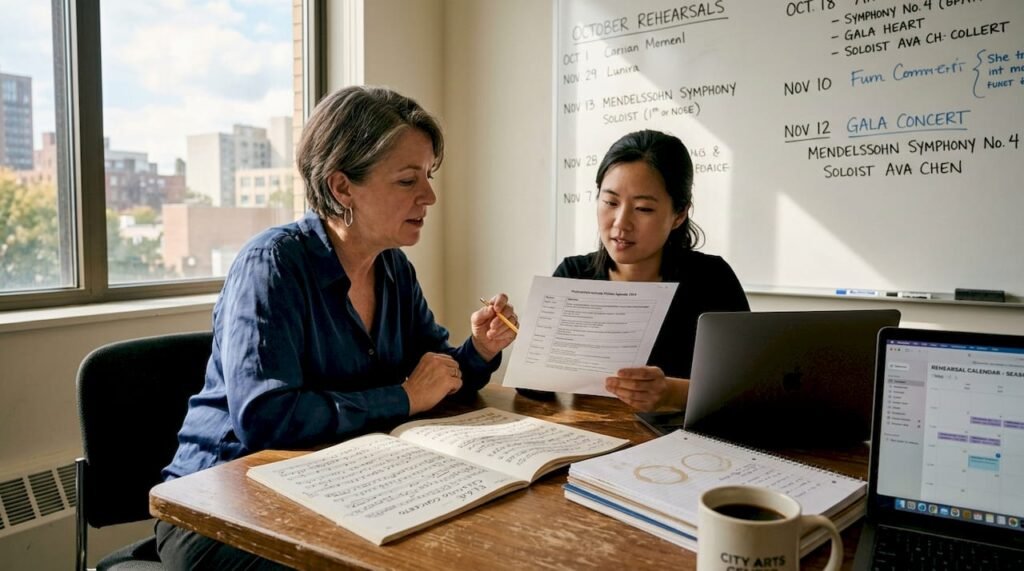
Balancing artistic ambition with practical constraints is, as the Victoria Symphony notes, a core challenge in orchestra season planning. You are managing budgets, venue calendars, musician capabilities, audience expectations, and repertoire diversity all at once. Get one element wrong and the whole season can feel off. This guide walks you through every stage of the process, from foundational principles to digital tools, giving you a clear, step-by-step system to build a season that is artistically strong, logistically sound, and genuinely engaging for your audiences.
Table of Contents
- Understanding the essentials: Foundations for season planning
- Strategic programming: Crafting your season’s narrative and mix
- Scheduling, logistics, and resource management
- Efficient communication and digital tools for orchestras
- Troubleshooting, evaluating, and sustaining success
- Our perspective: What most orchestra guides miss
- Streamline your season with digital management
- Frequently asked questions
Key Takeaways
| Point | Details |
|---|---|
| Balance artistry and practicality | Strong season planning blends creative ambition with logistical realism for best results. |
| Diversity matters | Even small programming adjustments can significantly boost diversity benchmarks. |
| Embrace digital tools | Modern communication and scheduling platforms make season management dramatically easier. |
| Plan and review holistically | Coordinate all season aspects upfront and conduct honest reviews for lasting improvements. |
Understanding the essentials: Foundations for season planning
Every well-run orchestra season begins long before the first rehearsal. The groundwork you lay in the planning phase determines whether your season flows smoothly or lurches from one crisis to the next. Think of it as architecture: the structure must be solid before you add any decoration.
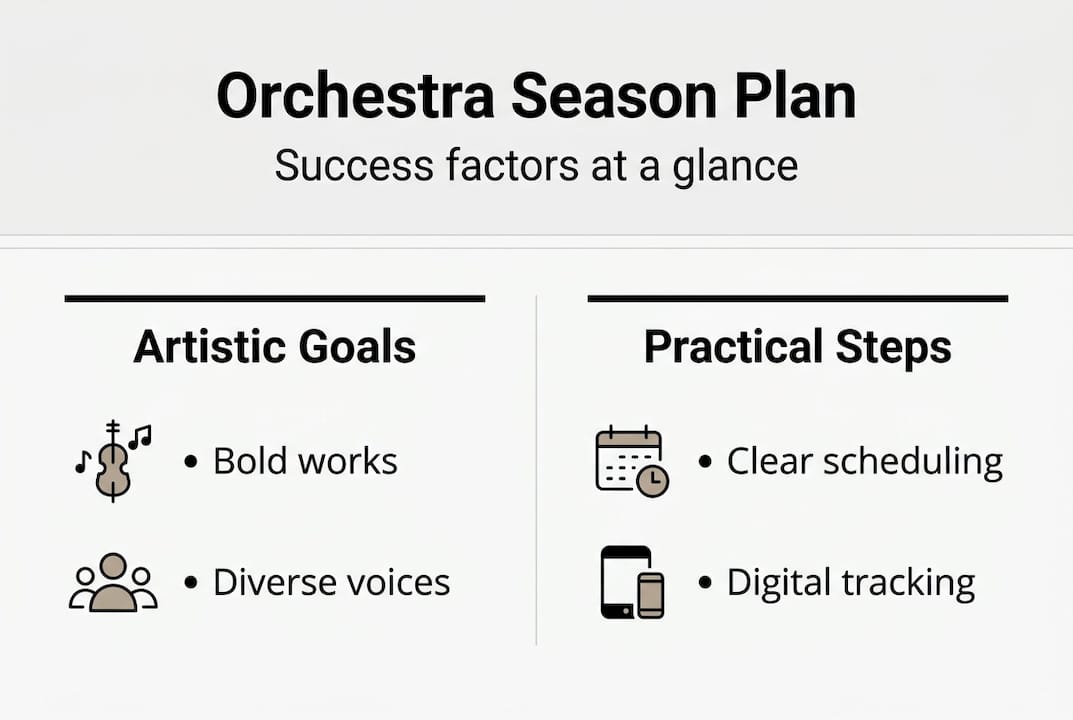
The two core tensions in season planning are artistic ambition and practical limitation. You want to programme bold, meaningful works, but you also need to stay within budget, keep your musicians challenged without overwhelming them, and retain your audience. Neither side of this tension should win outright. The best seasons hold both in balance.
Diversity is no longer optional. US orchestras programmed 22.6% works by women, non-binary, and composers of colour in 2023 to 2024, and benchmarks continue to push that figure higher. Setting a minimum diversity target at the start of your planning process keeps it from becoming an afterthought.
For repertoire balance, a widely recommended approach is the 30% easy, 60% core, 10% challenging split. This ensures audiences have familiar anchors while musicians are stretched and the season retains artistic credibility.
Season planning essentials checklist:
- Confirmed annual budget with contingency reserve
- Full personnel roster and instrument availability
- Venue calendar for the entire season
- Audience demographic and attendance data from previous seasons
- Diversity targets agreed upon before repertoire selection begins
- Guest soloist and conductor wish lists with fee estimates
| Planning element | Benchmark or target |
|---|---|
| Easy repertoire | ~30% of total programme |
| Core standard works | ~60% of total programme |
| Challenging or new works | ~10% of total programme |
| Diversity (women/non-binary/composers of colour) | Minimum 22.6%, rising annually |
| Budget contingency | 10 to 15% of total season budget |
Exploring the orchestra management features available to directors today can help you track these targets systematically rather than relying on memory or scattered spreadsheets.
Strategic programming: Crafting your season’s narrative and mix
With your essentials in place, we turn to the art of programming your season for maximum impact.
A season is not a list of concerts. It is a story. Each programme should have its own internal arc, and the programmes together should create a larger narrative that gives your audience a reason to return. Think about how a great meal works: the starter should intrigue, the main course satisfy, and the dessert linger. Your season works the same way.
Programming should create a narrative arc with a varied opener, contrasting works in the middle, and a powerful closer. The Florida Orchestra describes this as cooking a delicious musical meal, and the analogy holds. A season that opens with a crowd-pleaser, builds through adventurous mid-season programming, and closes with something emotionally resonant will feel intentional and satisfying.

Pro Tip: Use the “old, new, borrowed, blue” formula when building each programme. Something old (a beloved classic), something new (a recent or unfamiliar work), something borrowed (a cross-genre or cross-cultural piece), and something blue (an emotionally weighty or introspective work). This mix keeps every concert fresh without alienating your core audience.
Approaches to programming structure:
| Approach | Strengths | Potential drawbacks |
|---|---|---|
| Thematic seasons | Strong narrative, easy to market | Can feel restrictive for programming |
| Composer spotlights | Deep artistic focus | May narrow audience appeal |
| Balanced mixed programmes | Broad appeal, flexible | Can feel unfocused without careful curation |
| Diversity-led programming | Builds new audiences | Requires extra research and score sourcing |
When organising sheet music for diverse repertoire, digital libraries make it far easier to source and distribute parts for less frequently performed works. Swapping one or two standard works for pieces by underrepresented composers is one of the most practical steps you can take towards meaningful diversity without overhauling your entire season.
Programming diversity tactics:
- Replace one overture per season with a work by a composer of colour
- Feature at least one living composer per programme
- Pair unfamiliar works with well-known pieces to ease audience transition
- Consult musicians for suggestions from their own cultural backgrounds
Scheduling, logistics, and resource management
Programming choices in place, logistics and scheduling become your next major focus.
The single biggest logistical mistake orchestras make is leaving scheduling too late. Planning the entire season in advance is strongly recommended, including rehearsal time, soloist availability, and cost distribution across the year. Most professional orchestras work with three to four soloists per season, and the best artists book up quickly.
Step-by-step logistical checklist:
- Fix all concert dates before the season opens for ticket sales
- Book venues and confirm technical requirements for each programme
- Contact soloists and guest conductors at least 12 months in advance
- Map rehearsal schedules against musician contracts and union rules
- Distribute higher-cost programmes evenly to avoid budget clustering
- Set internal deadlines for score ordering, part distribution, and programme notes
- Build in contingency rehearsal time for complex works
Pro Tip: When approaching soloists, ask about availability and fees in the same conversation. A soloist who is available but out of budget is a problem you want to discover in month one, not month ten.
Last-minute programme changes are among the most expensive mistakes an orchestra can make. Reprinting materials, rescheduling rehearsals, and renegotiating contracts all carry hidden costs that quickly erode your contingency reserve. Lock in decisions early and change them only when absolutely necessary.
Using a dashboard for managers that consolidates scheduling, attendance, and budget tracking in one place removes a significant layer of administrative friction and reduces the risk of costly oversights.
Efficient communication and digital tools for orchestras
With logistics in hand, effective intra-orchestra communication and the right technology ensure everything runs to plan.
Digital apps for rehearsal scheduling, practice tracking, and note sharing measurably improve communication and efficiency across ensembles of all sizes. The days of relying on email chains and printed call sheets are behind us. Modern orchestras need real-time tools that keep everyone aligned without creating extra administrative work for the director.
Top communication and organisational tools for orchestras:
- Dedicated rehearsal scheduling apps with attendance tracking
- Digital sheet music platforms for instant part distribution
- Group messaging tools with role-based notifications
- Shared calendar integration for rehearsal and concert visibility
- Cloud-based score libraries accessible from any device
| Tool category | Key benefit | Best for |
|---|---|---|
| Rehearsal scheduling app | Real-time attendance and reminders | All ensemble sizes |
| Digital score library | Instant part distribution | Orchestras with large repertoire |
| Communication platform | Targeted notifications by section | Large ensembles |
| Calendar integration | Visibility across all stakeholders | Multi-venue seasons |
Setting SMART goals (Specific, Measurable, Achievable, Relevant, Time-bound) for sectionals and rehearsals helps musicians understand what is expected at each stage of preparation. Rather than saying “work on the Brahms,” a SMART goal might be: “Strings to achieve clean intonation in bars 45 to 78 by Thursday’s sectional.”
Exploring digital orchestra features and reading practical advice on the orchestra management tips blog can help you identify which tools fit your ensemble’s specific workflow.
Troubleshooting, evaluating, and sustaining success
Plans are rarely perfect from the outset, so troubleshooting and evaluation close the loop on season planning.
The orchestras that improve year on year are not the ones that get everything right first time. They are the ones that review honestly, adjust deliberately, and build institutional knowledge. A mid-season review and a full post-season audit should be standard practice, not optional extras.
Statistic to keep in mind: Many orchestras can meet diversity benchmarks by swapping just one to four works per season. That is a remarkably small change for a meaningful outcome.
Troubleshooting steps for common pitfalls:
- Attendance drop: Survey audiences, review programme accessibility, and check marketing reach
- Repertoire imbalance: Audit your season against the 30/60/10 framework and diversity benchmarks
- Budget overrun: Identify which cost categories exceeded estimates and adjust future contracts accordingly
- Musician fatigue: Review rehearsal density and consider redistributing technically demanding works
- Communication breakdown: Audit your current tools and identify where information is getting lost
Easy-to-implement improvement tactics:
- Introduce a post-concert debrief with section leaders
- Track attendance trends digitally to spot drops before they become patterns
- Rotate repertoire selection input among musicians to build ownership
- Review soloist and venue contracts annually for cost efficiency
Professional development is also part of sustaining success. The League of American Orchestras offers training programmes such as Essentials of Orchestra Management, which provide benchmarking data and best practice frameworks that are directly applicable to season planning.
Our perspective: What most orchestra guides miss
Most season planning guides focus on the mechanics and stop there. They tell you what to do but rarely explain why so many orchestras still struggle despite following the advice. Having worked closely with ensembles of all sizes, we think the gap is almost always cultural, not technical.
Diversity in programming does not happen because you tick a box once. It happens because your ensemble builds habits, policies, and a shared vocabulary around it. A single diverse concert is a gesture. A sustained commitment, reviewed annually and embedded in your planning process, is a genuine shift. The same applies to technology adoption. A scheduling app only works if your musicians actually use it, and that requires buy-in, training, and a leadership culture that models the behaviour.
Most guides also underplay the importance of narrative flow. A season that feels like a curated journey generates loyalty. One that feels like a random selection of works, however individually excellent, does not. We cover both the narrative and the troubleshooting in this guide because both matter enormously in practice. For more candid insights, the insights from our management blog regularly covers the real-world challenges directors face.
Streamline your season with digital management
If you are ready to move beyond spreadsheets and scattered email threads, WePlayIn.Band gives music directors and ensemble managers a single platform to handle scheduling, attendance, repertoire, and communication in one place.
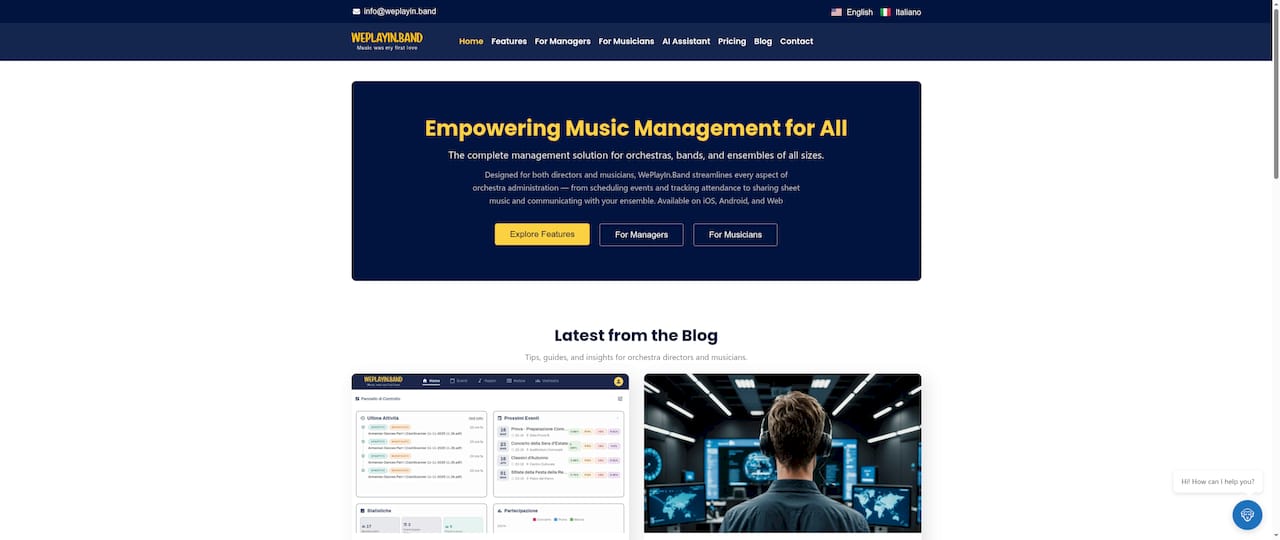
The dashboard for managers gives you real-time visibility across your entire season, while the orchestra management features handle everything from rehearsal notifications to digital score distribution. You can also explore our sheet music library guide to see how a well-organised digital library supports the kind of diverse, ambitious programming this guide recommends. Less administration means more time for the music.
Frequently asked questions
What is the recommended repertoire mix for an orchestra season?
Aim for roughly 30% easy, 60% core, and 10% challenging works to balance artistic depth with audience accessibility across the season.
How can I improve diversity in my orchestra’s programming?
Replacing just one to four works per season with pieces by women, non-binary, or composers of colour is often enough to meet current diversity benchmarks meaningfully.
What digital tools help with orchestra season planning?
Digital tools for scheduling and score sharing reduce logistical errors and keep your entire ensemble aligned without relying on manual processes or scattered communications.
How can I avoid costly mistakes in orchestral season planning?
Advance scheduling and careful budgeting prevent the most common and expensive errors, including last-minute programme changes and soloist availability conflicts.
