
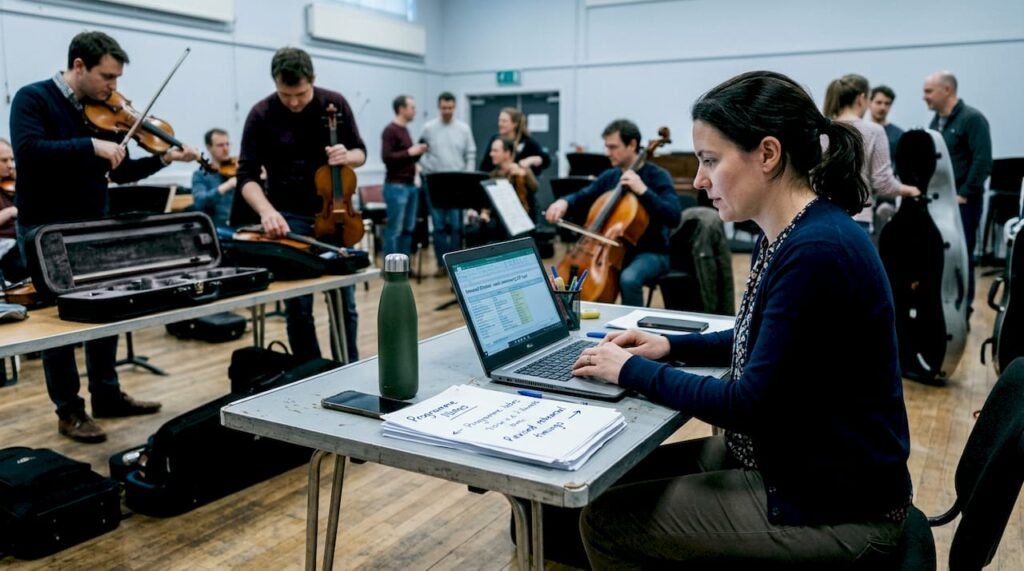
Even world-renowned orchestras spend a surprising amount of time on spreadsheets, email chains, and manual scheduling rather than music. The City of Birmingham Symphony Orchestra is one of many leading ensembles that have discovered time savings exceeded expectations after adopting automated systems. If you manage an orchestra or ensemble, you already know the admin burden is real. Rehearsal schedules shift, attendance records pile up, and financial reports demand hours you simply do not have. This guide cuts through the noise and explains exactly what automation means for musical organisations, which tools deliver results, and how to implement change without disrupting your team.
Table of Contents
- Understanding automation in the orchestra context
- Key automation solutions for orchestras
- Transformational impact: Real results from automation
- Nuances and adoption: Addressing challenges and edge cases
- Maximising benefits: Practical tips for successful implementation
- A fresh perspective: Why orchestral automation changes more than just admin
- Discover automation solutions for your orchestra
- Frequently asked questions
Key Takeaways
| Point | Details |
|---|---|
| Admin tasks streamlined | Automation dramatically reduces time spent on routine scheduling, financials, and communication. |
| Scalable solutions | Modern platforms are accessible to both small community groups and professional orchestras. |
| Staff empowerment | Freeing up staff from repetitive work allows more focus on artistry, audience engagement, and strategy. |
| Adoption beyond technology | Successful automation depends as much on change management as on software choice or features. |
Understanding automation in the orchestra context
When most people hear the word automation, they picture robots or complex software requiring an IT department. For orchestras, the reality is far more practical and far less intimidating.
Automation in a musical organisation means using software to handle repetitive administrative work so your people can focus on what actually matters: the music and the audience. It is not about replacing musicians or removing human judgement from artistic decisions. It is about removing the grunt work that slows everyone down.
Here is what automation typically covers in an orchestral setting:
- Event scheduling and rehearsal coordination across multiple venues and musician rosters
- Attendance tracking with real-time updates rather than manual registers
- Score library management so musicians always access the correct version
- Financial reporting including payroll, invoicing, and reconciliation
- Ticketing integration that syncs box office data directly with your management system
- Internal communications through automated notifications and reminders
Administrative tasks such as scheduling, attendance, and financial reporting are the primary targets for automation in orchestras, using specialised platforms designed for musical organisations.
The event scheduling features available today go well beyond a shared calendar. They allow directors to set recurring rehearsals, flag conflicts automatically, and notify musicians without a single manual email.
Automation does not threaten artistry. It protects it. When your staff spend less time on data entry, they spend more time supporting musicians, engaging audiences, and planning bold programmes.
This distinction matters enormously. Resistance to automation often comes from a fear that technology will change the character of an ensemble. In practice, the opposite tends to be true.
Key automation solutions for orchestras
With a shared definition in place, let us explore the leading solutions orchestras are using to automate critical processes.
Several platforms have emerged specifically for musical organisations, each addressing different parts of the administrative workflow. Here is a practical comparison:
| Platform | Primary focus | Best suited for |
|---|---|---|
| WePlayIn.Band | Scheduling, attendance, scores, AI assistant | All ensemble sizes |
| OPERA ERP | Full enterprise resource planning | Large professional orchestras |
| iplicit | Cloud accounting and financial reporting | Finance teams and administrators |
Each platform handles routine functions automatically. Real-time integrations including ticketing and payroll sync, combined with AI-powered voice assistants for event creation, mean that even non-technical staff can manage complex admin tasks confidently.
WePlayIn.Band includes Wolfgang, an AI voice assistant that lets directors create events, check attendance, and query the schedule using plain language commands. You do not need to navigate menus or understand database logic. You simply ask.
Key capabilities across leading platforms include:
- Automated reminders sent to musicians before rehearsals and concerts
- Bank feed reconciliation that reduces manual bookkeeping by hours each week
- Score distribution tied directly to the rehearsal schedule
- Payroll synchronisation that removes the need for separate data entry
The manager dashboard in WePlayIn.Band consolidates all of these functions into a single view, accessible from both web and mobile. The financial management update introduced music scanning alongside financial tools, showing how integrated these platforms have become.
Pro Tip: When evaluating platforms, ask specifically whether the system scales with your ensemble size. A community band and a professional symphony have very different needs, and the best tools accommodate both without charging enterprise rates for basic features.
Transformational impact: Real results from automation
We have seen the tools. Now, what can these systems actually achieve for orchestras in practice?
The evidence is compelling. The City of Birmingham Symphony Orchestra exceeded time savings expectations after transitioning from manual spreadsheets to automated financial processes through iplicit. Staff reported higher confidence in their numbers and faster book-closing cycles.

Here is a summary of the measurable improvements orchestras commonly report after adopting automation:
| Area | Before automation | After automation |
|---|---|---|
| Monthly book closing | Several days | Hours |
| Reconciliation time | Manual, error-prone | Automated, real-time |
| Attendance tracking | Paper registers | Instant digital records |
| Financial reporting | Delayed, uncertain | Confident, on-demand |
| Staff focus | Reactive admin | Strategic planning |
These are not marginal gains. Faster reporting directly improves decision-making. When a director can see real-time financial data rather than waiting for a monthly summary, they can respond to budget pressures, plan touring schedules, and allocate resources far more effectively.
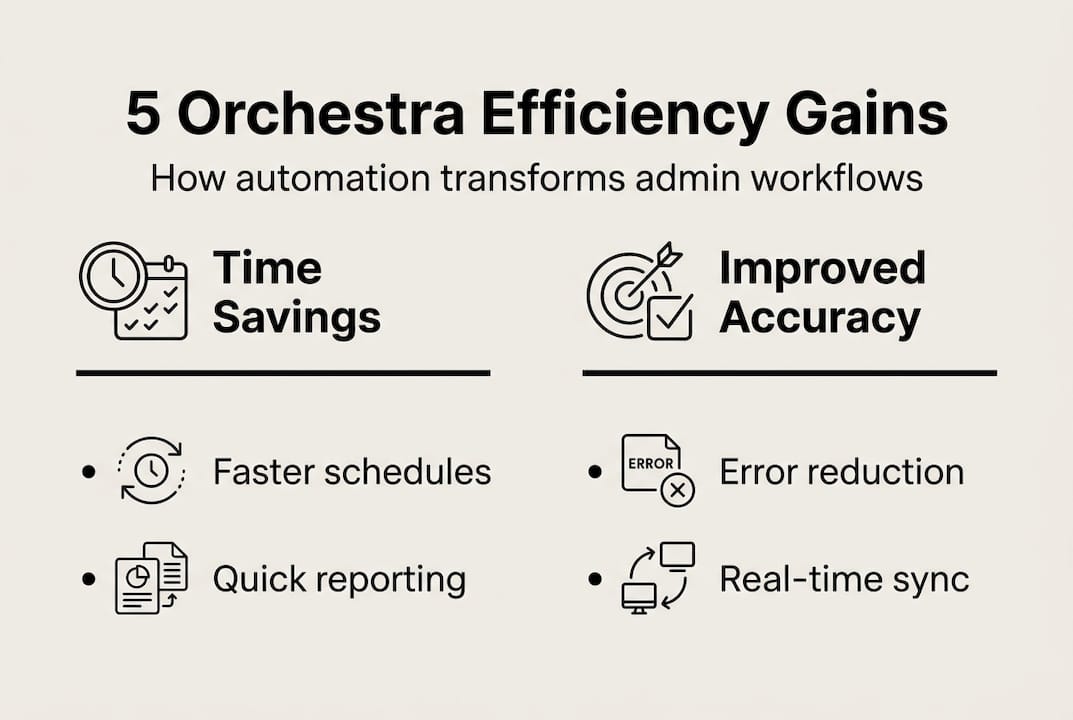
The CBSO’s experience is particularly instructive because it demonstrates that even organisations with significant resources and established processes can find substantial inefficiencies in their admin workflows.
For orchestra management tips that apply to a broader range of ensembles, the principle holds at every level. A regional youth orchestra saving two hours per week on attendance tracking gains over 100 hours annually. That is time redirected towards recruitment, community engagement, or simply better rehearsal preparation.
The results extend well beyond top-tier orchestras. Scalable platforms mean that a 30-piece community ensemble can access the same quality of automation as a major symphony, at a price point that reflects their size.
Nuances and adoption: Addressing challenges and edge cases
Even the best technology needs smart adoption. Let us address both the practical limits and the cultural factors involved.
Automation is not a switch you flip. It requires adjustment, patience, and a willingness to change established habits. Here are the most common adoption challenges and how to address them:
- Cultural resistance is the most significant barrier. Staff who have managed with spreadsheets for years may feel threatened or sceptical. Involve them early, explain the benefits clearly, and let them see results before expecting full buy-in.
- Data migration from legacy systems can be time-consuming. Plan for this phase carefully and allocate dedicated time rather than treating it as a side task.
- Training gaps slow adoption. Prioritise platforms with intuitive interfaces and voice-driven tools that reduce the learning curve for non-technical staff.
- Scope creep happens when teams try to automate everything at once. Start with the highest-impact bottleneck, prove the value, then expand.
- Artistic boundaries must be respected. Automation handles routine tasks; creative and managerial decisions remain firmly human.
Smaller and regional orchestras have access to genuinely exciting innovations. Low-cost video automation for archiving without camera crews is now available through tools like Notation AI, meaning even ensembles without broadcast budgets can build a professional archive of their performances.
Automation eliminates routine tasks like spreadsheets and emails but requires a cultural shift. It is not a replacement for creativity; it focuses on repetitive work to free staff for strategy. The best practices for adoption consistently emphasise change management over technical skill.
The organisations that struggle most with automation are not those with the least technical knowledge. They are those that underestimate how much their culture needs to shift alongside their software.
Pro Tip: Appoint an internal automation champion, someone enthusiastic about the tools who can support colleagues, answer questions, and celebrate early wins. This role is often more valuable than any external consultant.
Maximising benefits: Practical tips for successful implementation
Understanding both possibilities and limitations, what are the best practices for orchestras ready to embrace automation?
Successful implementation follows a clear pattern. Here is what works:
- Audit your admin bottlenecks first. Map out every recurring task that consumes staff time. Scheduling conflicts, attendance chasing, and financial reconciliation are usually the biggest offenders.
- Choose platforms built for music organisations. Generic project management tools rarely account for the specific rhythms of rehearsal cycles, concert seasons, and musician contracts.
- Prioritise intuitive interfaces. AI assistants like Wolfgang enable natural language admin, which is ideal for directors managing without IT expertise. If your team can speak to the software, adoption accelerates dramatically.
- Set measurable targets before you start. Decide in advance what success looks like: hours saved per week, reporting speed, reduction in missed communications. This makes it far easier to validate the investment.
- Build feedback loops. Schedule regular check-ins with staff during the first three months. Problems surface quickly when people feel safe to raise them.
The software comparison guide available from WePlayIn.Band offers a detailed breakdown of how leading platforms compare across these criteria, which is genuinely useful when you are narrowing down your options.
Pro Tip: Do not wait for the perfect moment to start. Pick one process, automate it well, and let the results build momentum across your organisation.
A fresh perspective: Why orchestral automation changes more than just admin
Having looked at implementation, it is worth pausing to consider why automation really matters to orchestras beyond efficiency quotas.
Most conversations about automation focus on direct time savings. That framing is understandable but incomplete. The deeper value lies in cultural transformation.
When your administrative staff are no longer buried in reconciliation spreadsheets or chasing attendance confirmations, something shifts. They begin to think strategically. They engage more meaningfully with musicians. They contribute ideas about programming, community outreach, and audience development because they finally have the mental space to do so.
We believe the organisations that see the greatest long-term benefit from automation are not those that implement the most tools. They are those that use automation to realign their people toward purpose. The insights on orchestral management we share consistently point to one truth: technology serves people best when it removes friction rather than adding complexity.
Automation, done well, builds more resilient and inspiring teams. That is the outcome worth pursuing.
Discover automation solutions for your orchestra
If the results described in this article sound like what your ensemble needs, the good news is that getting started is far simpler than most directors expect.
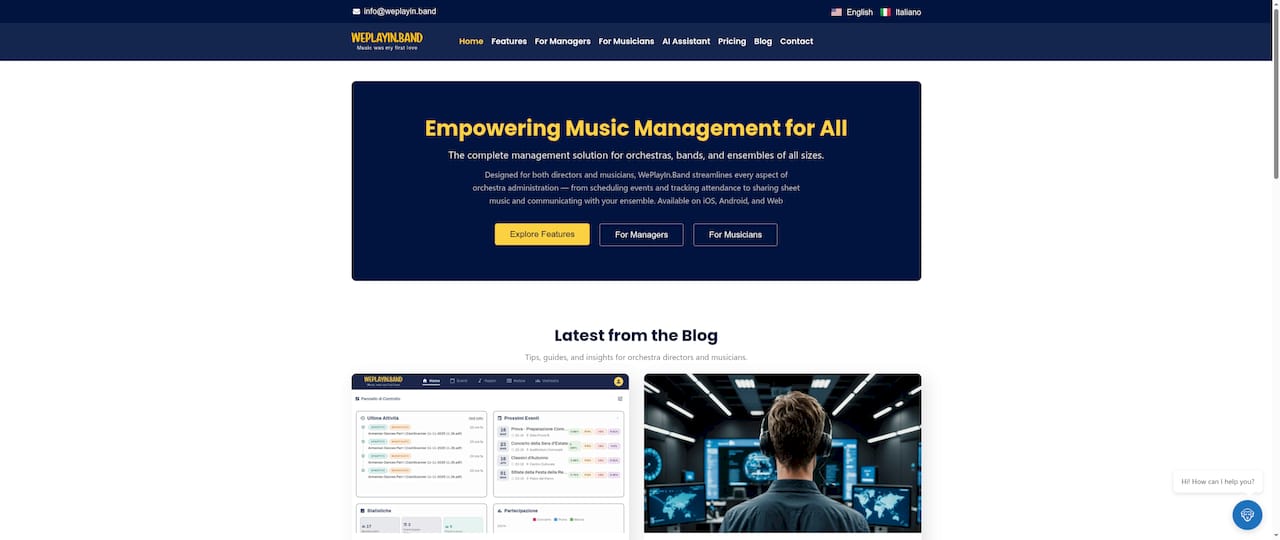
WePlayIn.Band is built specifically for orchestras, bands, and ensembles of every size, from community groups rehearsing in school halls to professional symphonies managing complex touring schedules. The orchestra dashboard features give you a real-time view of your entire operation, while the core automation features handle the repetitive tasks that currently consume your team’s time. Explore the community and professional pricing to find a plan that fits your ensemble’s scale and budget. The first step toward a more efficient, more musical organisation is just one click away.
Frequently asked questions
What tasks in orchestras are commonly automated?
Commonly automated tasks include scheduling, attendance tracking, ticketing, musician management, financial reporting, and score distribution. These are the repetitive processes that consume the most administrative time in musical organisations.
Is automation suitable for small or community ensembles?
Yes, scalable plans for all sizes mean that community orchestras and amateur ensembles can access the same quality of automation tools as professional symphonies, at pricing that reflects their budget.
Does automation in orchestras replace creative or artistic roles?
No. Automation targets routine tasks such as scheduling and financial reconciliation, freeing directors and staff to focus on the creative and strategic work that defines a great ensemble.
How do orchestras get started with automation?
Begin by identifying your biggest admin bottleneck, then choose a platform with an intuitive interface. AI-driven natural language tools like Wolfgang make it straightforward for directors without technical backgrounds to manage the transition confidently.
Are there real results from orchestral automation?
Absolutely. The CBSO exceeded time savings targets after adopting automated financial processes, reporting faster book closing and significantly higher confidence in their financial data.
