
Running a community orchestra is one of the most rewarding — and exhausting — things a musician can do. You started because you love music, but somewhere along the way you also became an event planner, attendance tracker, WhatsApp group moderator, and filing clerk for sheet music.
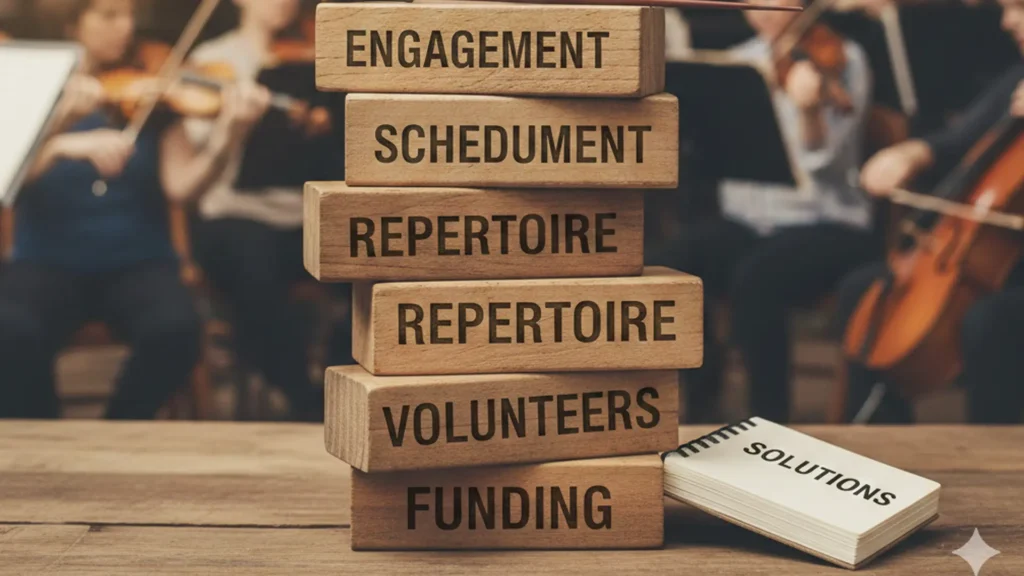
If any of that sounds familiar, you’re not alone. After talking with dozens of orchestra directors across Europe and the Americas, we’ve identified the five challenges that come up again and again — and the practical solutions that actually work.
1. The Attendance Mystery
“Who’s actually coming to Thursday’s rehearsal?” It’s the question that keeps directors up at night. You send a message to the group chat, three people respond, and then the message gets buried under a flood of unrelated conversation. By rehearsal day, you have no idea whether you’ll have a full string section or just two violins and a cello.
The core problem isn’t that musicians are unreliable — it’s that the tools most orchestras use (WhatsApp, email, spreadsheets) weren’t designed for attendance tracking. Musicians forget to respond, responses get lost, and there’s no easy way to see the big picture.
What works: A dedicated system where musicians can report their availability with one tap — Yes, No, or Maybe — and where directors can see attendance by section and position in real time. Automatic reminders help catch the musicians who simply forgot to respond. When you can see at a glance that you’re missing all your oboes, you can make arrangements before it’s too late.
2. The Sheet Music Chaos
Every orchestra has a sheet music system. The problem is that most of these systems involve some combination of a filing cabinet, a shared Google Drive folder with 47 subfolders, and PDFs named things like “Beethoven_5_FINAL_v3_REAL_FINAL.pdf”.
Musicians need their specific parts — the first violinist doesn’t need the tuba part — but most file-sharing systems show everything to everyone. And when a piece gets updated, there’s no guarantee everyone has the latest version.
What works: A music library where directors can upload PDF scores and control who sees what. Set visibility by section or even by specific position, so musicians automatically see only their relevant parts. When you update a score, everyone gets the new version instantly. Some systems even let musicians annotate their parts digitally — highlighting, drawing bowings, adding notes — so their marked-up score is always accessible from any device.
3. The Communication Overload
Group chats are great for casual conversation, but terrible for orchestra management. Important announcements about venue changes get buried under birthday wishes and memes. When you need to tell only the brass section about an extra rehearsal, you either have to create yet another group chat or send a message to everyone and hope the right people see it.
What works: Targeted communication channels where you can send messages to the whole orchestra, specific sections, or even individual positions. Priority levels help flag urgent announcements, and expiration dates keep your communication channels clean by automatically removing outdated messages. Push notifications ensure the important stuff gets through.
4. The Event Planning Puzzle
A single concert involves dozens of moving pieces: venue booking, dress code communication, program planning, parking arrangements, dinner reservations. Most directors manage all of this across multiple platforms — a calendar here, a spreadsheet there, a group chat everywhere.
Then there are the questions that come with every event. “Are you joining for dinner after the concert?” “Do you need parking?” “Can you bring a music stand?” Collecting and tracking these answers manually is a job in itself.
What works: A centralized event management system where you create the event once and everything flows from there. Attach the program, set the venue (with map directions), specify the dress code, and add custom questions — all in one place. Musicians get a push notification, can see all the details, report their availability, and answer questions right away. You get a dashboard showing exactly who’s coming, who needs parking, and how many are joining for dinner.
5. The Organizational Knowledge Gap
When you run an orchestra with spreadsheets and group chats, all the organizational knowledge lives in your head (or scattered across your devices). What happened at last month’s rehearsal? Who was absent for the past three concerts? Which venue has parking issues? When does the rent for the rehearsal space need to be paid?
If you’re unavailable — or if leadership changes — all of that institutional knowledge can be lost.
What works: A system that serves as the orchestra’s organizational memory. An operations log tracks all changes and decisions. Venue notes preserve practical details about each location. Attendance analytics reveal patterns over time — which musicians are consistently absent, which positions are chronically understaffed. Historical data about events, repertoire performance history, and musician participation builds up over time, creating a knowledge base that outlives any individual director.
The Bottom Line
These five challenges share a common thread: they all stem from using general-purpose tools for a specialized job. WhatsApp, Google Drive, and Excel are excellent tools, but they weren’t built for orchestra management. When you replace them with a purpose-built platform, you spend less time on administration and more time on what brought you to music in the first place.
That’s exactly why we built WePlayIn.Band — a platform designed by musicians and tech experts specifically for orchestras, bands, and ensembles. Whether you lead a 15-member brass band or a 100-piece symphony, having the right tools makes all the difference.
